By Sean Irvine, Inside Motivation
When an employee resigns, many managers reach for the same solution: find the old job advertisement, refresh a few details, and repost it within the week. It feels efficient, but reposting an old ad is a replacement decision. It skips the question that matters more: what does this role actually need to do now? I ran manufacturing operations for 26 years and made that move more times than I want to admit.
There is a research-backed way to test whether a role is well designed to attract and keep high-quality people.
Why the old job advertisement no longer fits
A role can drift a long way out of date without anyone noticing. Imagine a position held by the same person for six years. Over that time the business has almost certainly changed: new customers, new systems, and new processes that didn’t exist when the role was first written. The person adapted as things changed, but the underlying job description stayed frozen from the day they started.
When you repost that old advertisement, you are describing the previous employee and how the business used to work, rather than the work the business needs done today. The more useful approach is to design against the role, not against the last person who held it. Three questions help:
- What does this role need to deliver over the next two years?
- What should other members of the team take on instead?
- Is it still one job, or has it become two jobs joined together by history?
Rebuild the role before you advertise
Answering those questions takes about an hour. Set that time aside with the people who understand the work best, and include your HR manager if you have one. The goal is to rebuild the role around what the business needs now, so that what you advertise is clear, defensible, and current.
Once the role is redesigned, one question remains: would a strong candidate actually want it? Answering that objectively is easier with a framework, which is where the next section comes in.
The Job Characteristics Model: five features of a motivating role
In the 1970s, researchers Richard Hackman and Greg Oldham developed the Job Characteristics Model to measure how motivating a job is in itself. This is separate from pay, perks, or the quality of management. Their model identifies five features:
- Skill variety – the range of skills and abilities the work genuinely calls on.
- Task identity – whether the role owns complete pieces of work from start to finish, rather than isolated fragments of other people’s processes.
- Task significance – how clearly the work matters to others, inside or outside the organisation.
- Autonomy – how much freedom the person has to decide how the work gets done.
- Feedback – whether the work itself shows the person how well they are performing.
A role that scores well on all five tends to engage the people who hold it. A role that scores poorly tends to be filled reluctantly and vacated quickly.
The Motivating Potential Score, and why it isn’t a simple average
Hackman and Oldham combined the five features into a single measure called the Motivating Potential Score. Each feature is rated from 1 to 7, ideally from the perspective of the person who will actually hold the job:
Motivating Potential Score = (skill variety + task identity + task significance) ÷ 3 × autonomy × feedback
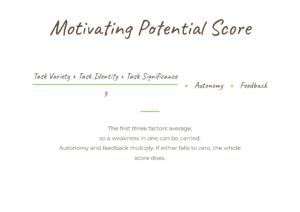
The structure of this formula is worth understanding, because it explains a lot about why some roles fail to attract good people. The first three features are averaged, which means a role can make up for a lower score in one area with a higher score in another. For example, a little less variety, in exchange for more meaning.
Autonomy and feedback, however, are multipliers. In Hackman and Oldham’s model a motivating job needs both: genuine say over how the work is done, and a clear sense of how it is going. A low score in either one pulls the entire result down, no matter how varied or meaningful the work is. In practical terms, a role that gives someone little say over how the work is done, or little sense of how they are performing, cannot be rescued by interesting tasks alone.
A worked example: the same role, scored two ways
To see how this works, consider two versions of the same operations role, on the same salary.
The first version is the old advertisement, reposted with minor updates:
- Skill variety: 5 – the role touches many parts of the business
- Task identity: 3 – it handles fragments of other people’s processes
- Task significance: 6 – customers notice when it goes wrong
- Autonomy: 2 – most exceptions are escalated to a manager
- Feedback: 2 – information arrives late and second hand
This produces a score of roughly 19, out of a possible 343. A role scoring this low tends to attract candidates who simply need a job, and to fall vacant again sooner than expected.
The second version is redesigned around current needs. Decisions about freight are built into the role, so autonomy rises to 5. Supplier issues are handled from start to finish, so task identity rises to 5. The role deals with customers directly, so feedback now arrives firsthand from customers and rises to 5. The score climbs to around 133, for the same salary. It is, in effect, a different and far more appealing job. The scores here are illustrative; the mechanism is not.
Two important cautions
Two points are worth keeping in mind when you apply the model.
First, score the role honestly, from the perspective of the person who will do it rather than from a manager’s chair. Hiring managers tend to rate their own vacancies more generously than the people who eventually fill them would.
Second, the model measures the job, not the candidate. Assessing individual applicants is a separate discipline. The Motivating Potential Score only tells you whether the role itself is well designed.
Key takeaways
Before advertising a vacancy, it pays to design the role rather than simply replace the person who left. In summary:
- Ask what the role needs to achieve now, not what the previous holder did.
- Rebuild it around current business needs before you write the advertisement.
- Use the five job characteristics: skill variety, task identity, task significance, autonomy, and feedback, to gauge how motivating the role is.
- Pay particular attention to autonomy and feedback, which have the greatest influence on the score.
- Remember that the score reflects the design of the job, not the quality of any candidate.
A well-designed role is easier to fill, more likely to attract strong candidates, and far more likely to keep them.
———————————————–
Sean Irvine spent 26 years running manufacturing operations before founding Inside Motivation, where he works with leadership teams on team effectiveness and the design of roles. insidemotivation.com.au